Middle Earth HR empowers HR professionals with future-ready L&D, leadership influence, and strategic people development skills in India.
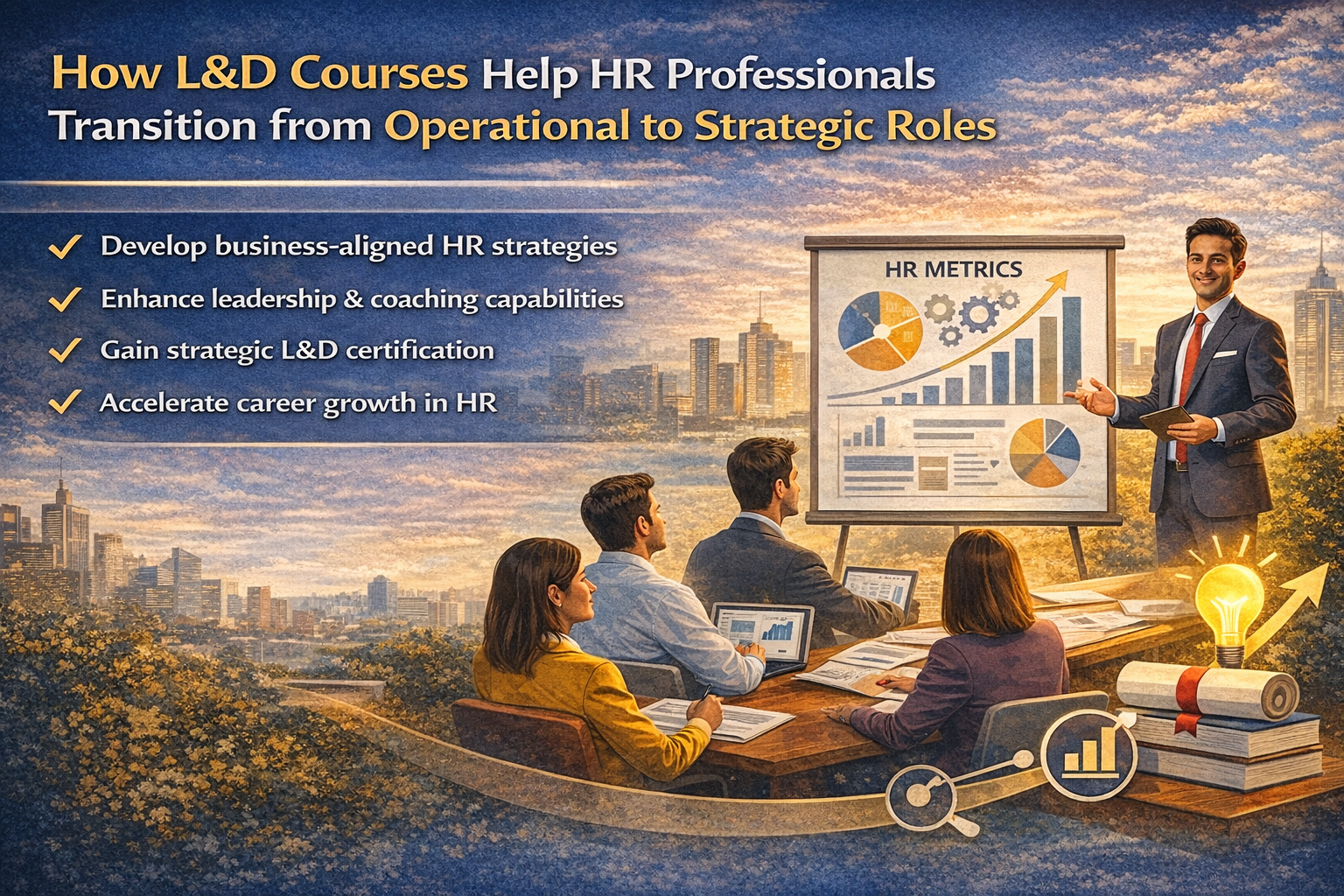
The role of Human Resources has evolved significantly over the past decade. Traditionally viewed as an administrative function responsible for payroll, compliance, and employee records, HR is now expected to play a far more strategic role within organizations. Modern businesses rely on HR not just for operational support, but for driving performance, building future-ready capabilities, and enabling long-term growth.
Organizations today expect HR professionals to align people strategies with business goals, develop leadership pipelines, and support transformation initiatives. This shift requires HR professionals to move beyond transactional tasks and adopt a broader, business-oriented mindset.
One of the most effective ways to enable this transition is through Learning & Development (L&D). Structured L&D courses, supported by recognized L&D certification and even coach certification programs, equip HR professionals with the skills, credibility, and strategic perspective required to step into influential leadership roles.
Strategic HR goes far beyond managing policies or handling employee concerns. In today’s business environment, strategic HR professionals act as partners to leadership, contributing directly to organizational direction and performance. Their focus is on anticipating future workforce needs, building capabilities, and ensuring that people strategies support overall business objectives.
Key responsibilities of strategic HR include workforce planning, where talent requirements are aligned with business growth plans; talent development, which ensures employees continuously build relevant skills; and leadership capability building, which strengthens the organization’s ability to execute strategy effectively. Strategic HR also plays a critical role in aligning culture, performance management, and learning initiatives with organizational goals.
This approach is distinctly different from traditional HR roles. While traditional HR focuses on execution and administration, strategic HR emphasizes analysis, influence, and long-term planning. Professionals operating at this level are expected to understand business challenges, interpret data, and propose people-focused solutions. Building these capabilities often requires formal learning, such as a learning & development diploma, combined with strong foundations in strategic HR and HR leadership.
Strategic HR Program
Learning & Development sits at the intersection of people, performance, and business outcomes, making it a natural gateway for HR professionals aspiring to strategic roles. Unlike purely administrative HR functions, L&D requires professionals to deeply understand business strategy, future skill requirements, and organizational performance gaps.
L&D professionals influence organizational growth by designing programs that upskill employees, prepare leaders, and support transformation initiatives. Whether it is digital transformation, leadership succession, or cultural change, L&D plays a central role in enabling successful execution.
Exposure to L&D courses helps HR professionals develop a broader business mindset. They learn how to diagnose capability gaps, design scalable learning solutions, and measure the impact of training on performance. These experiences prepare HR professionals to move into learning and development roles that demand strategic thinking, cross-functional collaboration, and leadership influence.
Professional L&D courses are designed to build both strategic and executional capabilities required for modern HR roles. These programs move beyond theory and focus on real-world application.
One of the most powerful outcomes of L&D education is the shift from task execution to advisory roles. HR professionals trained in L&D are no longer seen as administrators, but as strategic contributors who can guide leaders on capability building and performance improvement.
L&D courses help professionals speak the language of business leaders—using data, outcomes, and strategy rather than processes alone. This confidence enables HR professionals to contribute meaningfully to leadership and boardroom discussions.
Earning an L&D certification strengthens credibility and signals readiness for strategic responsibilities. Combined with hands-on learning and exposure to real business challenges, L&D courses help HR professionals develop the strategic HR skills needed to influence organizational direction.
L&D expertise opens up multiple career pathways for HR professionals. Common transitions include moving from HR Executive roles into specialized L&D positions, or from HR Generalist roles into Strategic HR Business Partner positions.
Professionals with strong facilitation backgrounds can advance from Trainer roles to L&D Manager or Head of Learning positions. Others leverage L&D expertise to transition from internal HR roles into external consulting careers as learning and development advisors.
These transitions highlight the growing importance of L&D as a long-term L&D career path, particularly for those pursuing roles such as certified learning and development manager.
Organizations that invest in strategically trained HR professionals experience measurable benefits. Stronger leadership pipelines ensure continuity and readiness for future challenges. Improved employee performance and engagement result from well-designed learning interventions.
Strategic HR professionals also enhance change management and organizational agility by preparing employees for evolving roles and technologies. Over time, this leads to sustainable talent development and long-term business resilience. Programs such as a management development program online further amplify these outcomes.
Selecting the right L&D program is critical for HR professionals aiming for strategic growth. Effective L&D courses combine theory with practical application through hands-on projects and real organizational case studies.
A strong program should offer a business-focused curriculum that connects learning with performance outcomes. Blended learning formats—combining live sessions, self-paced modules, and practical assignments—support continuous upskilling.
Equally important is certification credibility. Recognized L&D certification programs enhance professional reputation and ensure industry relevance, helping HR professionals confidently step into strategic roles.
L&D courses are ideal for HR professionals aiming for leadership roles and greater strategic influence. HR generalists seeking specialization, trainers wanting broader business exposure, and professionals planning long-term HR career growth can all benefit.
Those pursuing coach certification or L&D manager training will find L&D programs particularly valuable, as they provide the tools, mindset, and credibility required for senior HR and learning leadership positions.
Strategic HR Program
The evolution of HR from operational support to strategic partnership requires new skills, perspectives, and capabilities. L&D courses empower HR professionals with the strategic insight, business alignment, and leadership skills needed to meet these expectations.
By combining structured learning, practical application, and recognized certification, L&D creates a future-ready pathway for HR professionals seeking long-term growth and influence. For those committed to building meaningful, strategic HR careers, Learning & Development is not just a function—it is a powerful catalyst for transformation.
Discover how Middle Earth HR can elevate your career — explore their programs today!
Middle Earth HR